
The 22nd Annual SLAIHEE conference on Higher Education was held on 24th July 2026 at the National Library of Sri Lanka Auditorium, No 14, Independence Avenue, Colombo 07. The theme of the conference this year was “Changing myself as an effective teacher for improving student needs & meeting them ” and it was organized by SLAIHEE and supported by IIT. The inauguration commenced with Dr. Iroja Caldera, Immediate Past President, SLAIHEE giving the opening remarks. It was followed by Dr Jinendra Dissanayake, President, SLAIHEE, welcoming the participants who were from several state and private sector universities. Following this welcome, Dr. H.G.P.A. Ratnaweera, Past President SLAIHEE, Senior Lecturer (Grade I), Civil Engineering, Faculty of Engineering Technology, The Open University of Sri Lanka delivered the keynote address on “staff development and institutional readiness for expanding higher education in Sri Lanka – are we there?” Following the keynote address, Prof Suki Ekaratne introduced the Dr Shrinika Weerakoon Memorial Award for the Best Paper in Changing Higher Education Student Skills. Next, the 2025 award joint-recipient of Dr Shrinika Weerakoon Memorial Award for the Best Paper in Helping educators and students reduce and manage perform anxieties in the year 2025, Ms. Azmiya Cassim and Ms. Rashmi Abyesekara received the award from Dr. Ruvan Weerasinghe, Dean Research at IIT. The inauguration concluded with a vote of thanks delivered by Ms. Abarnah Kirupananda, President-Elect, SLAIHEE. Soon after the inauguration the paper presentation session started. Well wishes were received from Mr Mohan Fernando, CEO of IIT, the Guest of Honour. Twenty eight peer reviewed papers were presented this year leading to lively discussions during the Q&A sessions. The papers focused on how teaching practices were improved by Sri Lankan university academics, in order to change them self as an effective teacher to improve their student needs and meet them. The Conference was followed by the AGM of SLAIHEE.
Author: slaihee
21st SLAIHEE Conference 2025
The 21st Annual SLAIHEE conference on Higher Education was held on 25th July 2025 at Informatics Institute of Technology (IIT) School of Computing, Colombo 03. The theme of the conference this year was “Helping educators and students reduce and manage performance anxieties” and it was organized by SLAIHEE and supported by IIT. The inauguration commenced with Dr. Iroja Caldera, Immediate Past President, SLAIHEE giving the opening remarks. It was followed by Dr Jinendra Dissanayake, President, SLAIHEE, welcoming the participants who were from several state and private sector universities. Following this welcome note, Professor Hemamalie Gunatilaka, member of University Grants Commission and Professor in Business Administration at the Department of Business Administration, Faculty of Management Studies and Commerce, University of Sri Jayewardenepura delivered the keynote address on “Helping educators and students reduce and manage performance anxieties”. Following the keynote address, Prof Suki Ekaratne introduced the Dr Shrinika Weerakoon Memorial Award for the Best Paper in Changing Higher Education Student Skills. Next, the 2024 award recipient of Dr Shrinika Weerakoon Memorial Award for the Best Paper in Facilitating Student Voice Generation through Teaching in the year 2024, Ms. P D J A Harischandra received the award from Mr Sudharshan Welihinda, COO of IIT. The inauguration concluded with a vote of thanks delivered by Ms. Abarnah Kirupananda, President-Elect, SLAIHEE. Soon after the inaguration the paper presentation session started after the address by the Guest of Honour, Mr Mohan Fernando, CEO of IIT. Seventeen peer reviewed papers were presented this year leading to lively discussions during the Q&A sessions. The papers focused on how teaching practices were improved by Sri Lankan university academics, in order to help reduce and manage performance anxiety in themselves and their students. The Conference was followed by the AGM of SLAIHEE.
Download 2025 Conference Keynote Speech by Professor Hemamalie Gunathilaka
20th SLAIHEE Conference 2024
The 20th Annual SLAIHEE conference on Higher Education was held on 26th July 2024 at Informatics Institute of Technology (IIT) School of Computing, Colombo 03. The theme of the conference this year was “Giving students a voice: evidence to have facilitated student voice generation through teaching” and it was organized by SLAIHEE and supported by IIT. The inauguration commenced with Professor Sunethra Perera, Immediate Past President, SLAIHEE giving the opening remarks. It was followed by Dr Iroja Caldera, President, SLAIHEE, welcoming the participants who were from several state and private sector universities. Following this welcome note, she invited the Guest of Honour, Mr Mohan Fernando, CEO of IIT and Professor Suki Ekaratne to launch the Academy for Learning & Teaching Effectiveness Facilitation (ALTEF) at IIT. Following the inauguration, Mr Mohan Fernando was invited to address the audience. Thereafter, Professor Suki Ekaratne, founder president of SLAIHEE and the founding Director of ALTEF delivered the keynote address on “Giving students a voice: evidence to have facilitated student voice generation through teaching”. Following the keynote address, Prof Suki Ekaratne introduced the Dr Shrinika Weerakoon Memorial Award for the Best Paper in Changing Higher Education Student Skills. Then the 2023 award recipients; Ms. Shalini Kaduwela and Ms. Abarnah Kirupananda received the awards from the Guest of Honor. The inauguration concluded with a vote of thanks delivered by Dr Jinendra Dissanayake, President-Elect, SLAIHEE. Eight peer reviewed papers were presented this year leading to lively discussions during the Q&A sessions. The papers focused on how teaching practices were improved by Sri Lankan university academics. in order to develop voicing skills in their students. The Conference was followed by the AGM of SLAIHEE.
This year the conference also included a post-lunch workshop facilitated by Prof Suki Ekaratne, titled “How can we get students to ‘understand well’ what we teach them”. It was attended nearly 80 participants. The workshop included group work and discussion which drew an enthusiastic response from participants.
Download 2024 Conference Keynote Speech by Professor Suki Ekaratne
19th SLAIHEE Conference 2023
The 19th Annual SLAIHEE conference was held on 28th July 2023 at Informatics Institute of Technology (IIT) School of Computing, Colombo 04. Held in face-to-face mode following three years of being held online, the conference was organized by SLAIHEE and supported by IIT. The theme this year was “Outcome-based higher education for developing knowledge-based procedures in students”. The inauguration commenced with Professor Sunethra Perera, Immediate Past President, SLAIHEE giving the opening remarks which was followed by Dr Iroja Caldera, President, SLAIHEE, welcoming the participants who were from several state and private universities. Following this welcome note, she invited the Guest of Honour, Mr Mohan Fernando, CEO of IIT to address the audience. Thereafter, Ms. Sajeewani D Somaratna, Acting Librarian, University of Colombo, delivered the keynote address on “Outcome-based higher education for developing knowledge-based procedures”. The inauguration concluded with a vote of thanks delivered by Dr Jinendra Dissanayake, President-Elect, SLAIHEE.Ten (10) peer reviewed papers were presented this year and these led to lively discussions during the Q&A sessions. The papers focused on how teaching practices were improved by Sri Lankan university academics and secondary school teachers in relation to how specified higher education skills are developed. The Conference was followed by the AGM of SLAIHEE.
This year the conference also included a post-lunch mini workshop facilitated by Prof Suki Ekaratne, Titled ‘Designing plans to improve selected student skills’ it included a group work session which had an enthusiastic response from participants. A 2-3 hour follow-up workshop is being planned for the same participants and based on what participants had completed at this mini-workshop,”
Download 2023 Conference Keynote Speech by Ms. Sajeewani D Somaratna
18th SLAIHEE Conference 2022
The 18th Annual SLAIHEE conference was held on 29th July 2022, online via Zoom. The theme this year was “Improving HE Student Skills for Work & Life Performance Readiness”. The inauguration commenced with Professor Sunethra Perera, SLAIHEE President, welcoming the participants who came from several Sri Lankan universities. Following this welcome, Professor Nelun de Silva, Department of Microbiology, Sabaragamuwa University of Sri Lanka, delivered the keynote address on “Improving HE Student Skills for Work & Life Performance Readiness”. The inauguration concluded with a vote of thanks delivered by Dr Iroja Caldera, President-Elect, SLAIHEE. This year, ten (10) peer reviewed papers were accepted and presented. These were on how teaching practices were improved by Sri Lankan university academics in relation to improving the skills of their students. The Conference was followed by the AGM of SLAIHEE.
Download Conference Keynote Speech by Professor Nelun de Silva
17th SLAIHEE Conference 2021
The 17th Annual SLAIHEE conference was held on the 30th of July 2021, online via Zoom. The theme this year was “Developing self-aware and self-directed students and staff”. Professor Sunethra Perera, the President SLAIHEE, welcomed the participants who came from several Sri Lankan universities and schools. Following the welcome address, Professor Pulani Lanerolle, Professor in Nutrition and Chair, Department of Biochemistry & Molecular Biology, University of Colombo, delivered the keynote address on “Towards Excellence: Effective Reflection”. The inauguration concluded with a vote of thanks delivered by Dr Iroja Caldera, President Elect, SLAIHEE. This year, twenty two (22) peer reviewed papers were accepted and presented. These were on how teaching practices were improved by Sri Lankan university academics and a paper by a secondary school teacher for improving HE-readiness in her students. The Conference was followed by the AGM of SLAIHEE.
Download Conference Keynote Speech by Prof. Pulani Lanerolle
Events
Workshop (Online): “Constructive Alignment” to plan teaching (held on Friday 4th March 2022: 9 a.m. to 12 noon)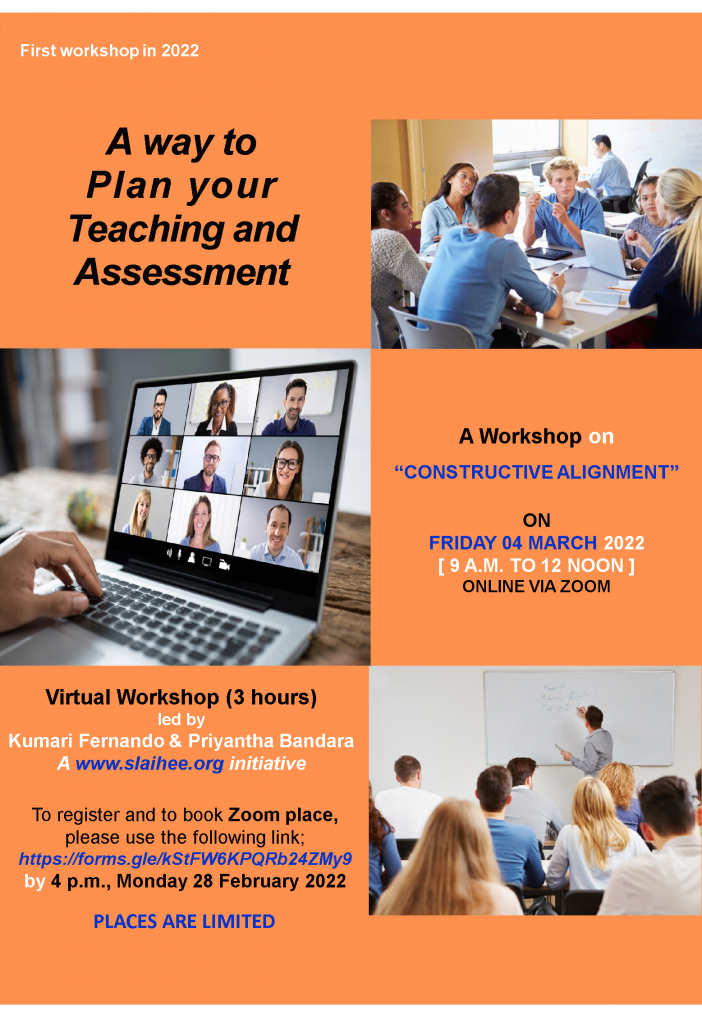
Workshop on Abstract Writing (held on 2021.02.12)
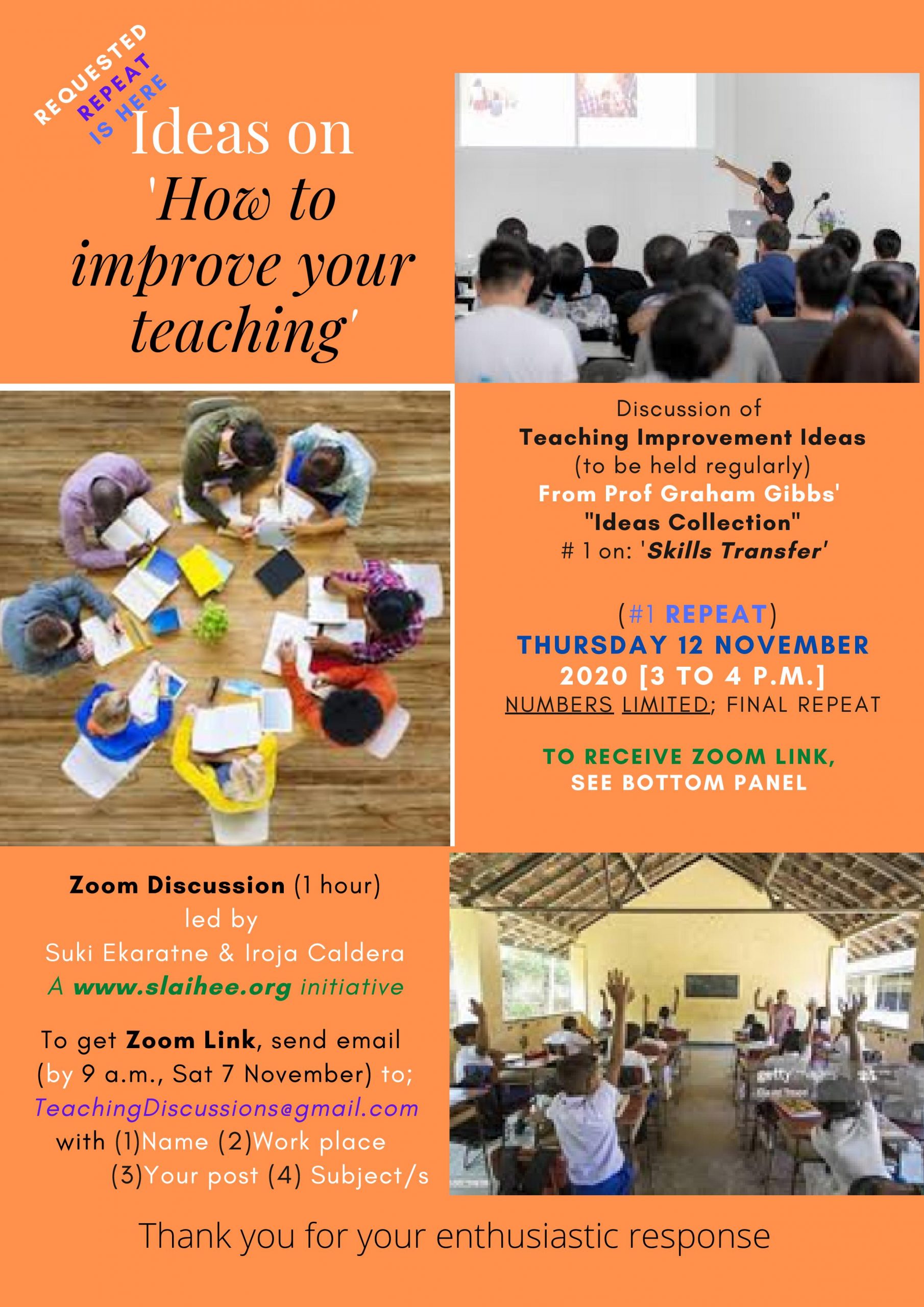
Online (via Zoom) Discussion held on 12th November 2020 (Click to Download)
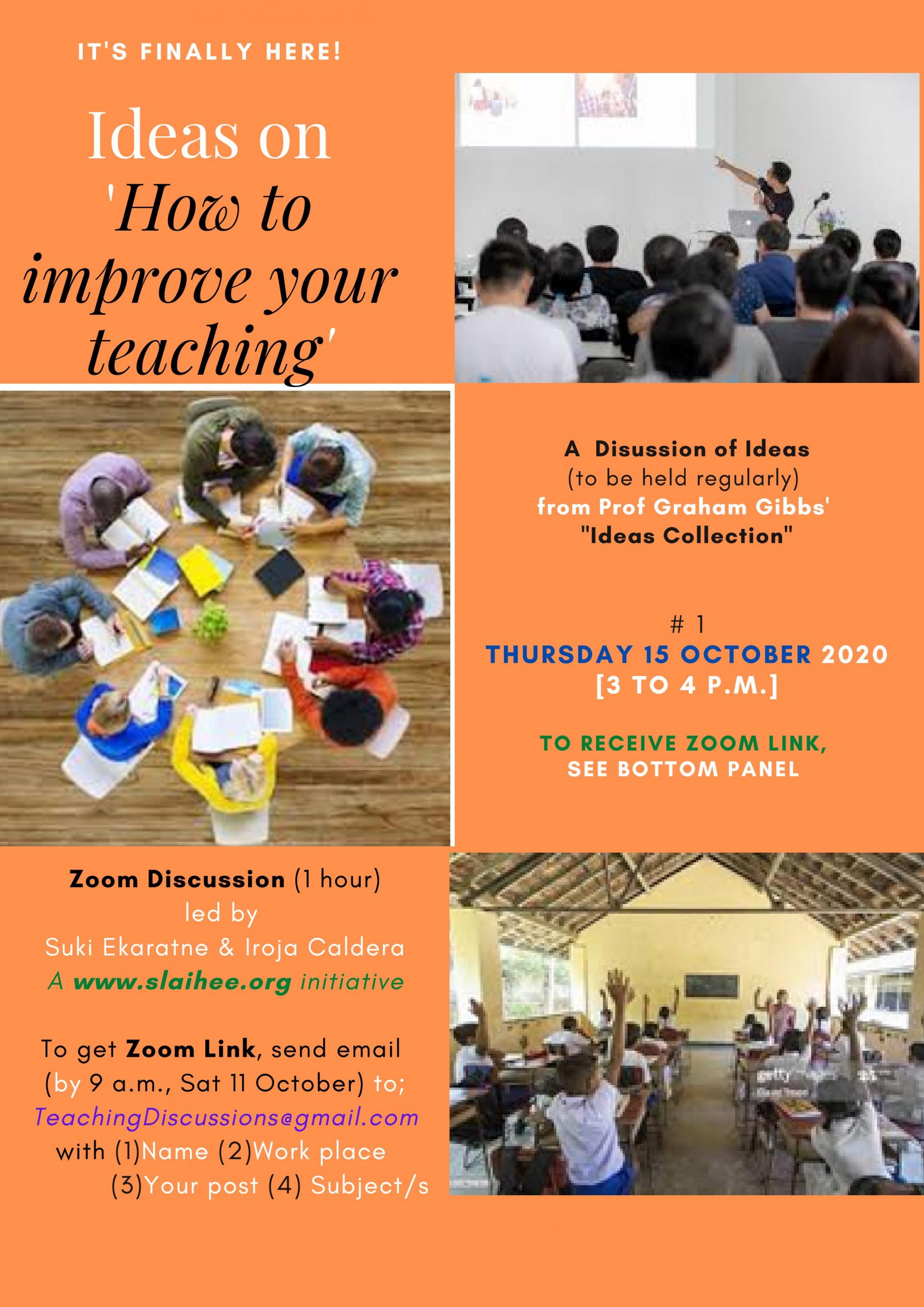
SLAIHEE Online (via Zoom) Discussion held on 15th October 2020 (Click to Download)
16th SLAIHEE Conference 2020
The 16th Annual SLAIHEE conference was held on the 24th of July, 2020 online via Zoom. The theme this year was “Developing & Sustaining Teaching and Learning Practices to meet Higher Education Needs”. Dr T. Sivakumar, the president SLAIHEE, welcomed the gathering. Following the welcome address, Professor Suki Ekaratne, Founding President of SLAIHEE, introduced the “Dr Shrinika Weerakoon Memorial Award for the Best Paper in Changing Higher Education Student Skills” and announced the 2019 winners. Dr Panduka Karunanayake, Senior Lecturer in Clinical Medicine, University of Colombo, graced the conference as the Chief Guest and delivered the keynote address on “Education’s ‘Three E’s’ and the McUniversities: Some Heretical Thoughts”. The inauguration concluded with a vote of thanks delivered by Dr Sunethra Perera, President Elect, SLAIHEE. This year, fourteen (14) peer reviewed papers were presented.
Download 2020 Conference Keynote Speech by Dr. Panduka Karunanayake
2025 Awardees
Note : Full papers of the 2025 Conference can be read here.
 |
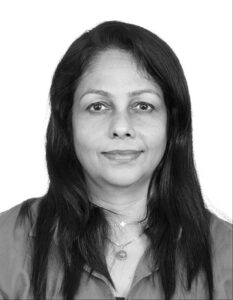 |
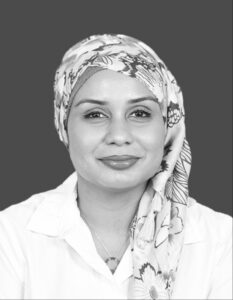
| Ms. Azmiya Yehiya Cassim Lecturer, School of Computing, Informatics Institute of Technologyazmiya.c@iit.ac.lk |
Rashmi Nirodha Arangalla Abeysekera Lecturer, School of Computing, Informatics Institute of Technology. rashmi.abeysekera@gmail.com( Now Lecturer at: Language Centre International College (LCIC), International College – Siam University, Thailand) |
| “Progressive Reduction of Speaking Anxiety Using Online Platforms, Gamified Tasks, and Targeted Feedback “
Motivated by the prevalent issue of speaking anxiety among English as a Second Language (ESL) students, our paper investigated a technology-mediated approach implemented within our English Communication Skills module. We had observed that numerous first-year students exhibited reluctance to engage in oral tasks, hindered by elevated stress levels and various learning obstacles that impeded effective practice. This behaviour, reflected through peak anxiety, clearly illustrated a common challenge students encounter in mastering a second language. Recognising the critical importance of strong communication skills for career success, this research explored transforming students into confident speakers by applying a structured Task-Based Language Approach (TBLA) alongside user-friendly digital tools. Platforms such as Padlet and Kahoot were utilised to establish a relaxed, collaborative environment for speaking tasks and interactive exercises. Throughout our sessions, students participated in a series of activities designed to enhance their skills and reduce the pressure of spontaneous speaking. By consistently repeating these activities throughout the semester, students received the practice needed to improve. The outcomes were highly positive: our final evaluations indicated a significant reduction in speaking anxiety, and students reported that these digital tools directly facilitated their progress. These findings demonstrate that integrating interactive digital tasks with collaborative teamwork can substantially reduce stress and enable students to articulate their thoughts more clearly. We are optimistic that this work will inspire both colleagues and students to incorporate technology into the classroom, and we intend to continue refining these methods to empower every learner to communicate their ideas effectively. |
|
2024 Awardees
Note : Full papers of the 2024 Conference can be read here.
 |
||
| Ms. Janani Harischandra Senior Lecturer, Department of ComputingInformatics Institute of Technologyjanani.h@iit.ac.lk |
||
| “Students’ Perceptions on Incorporating Student Voices and Group Work in Lectures to Transform Passive Students into Active Readers and Self-Learners”
This paper examines a self-learning activity implemented during my Web Technology class. Over the semester, I observed that many students were reluctant to engage with the assigned reading materials or supplementary study resources. They go by the traditional way of taking notes home. This behavior is indicative of passive learning tendencies. Given the critical role of reading in fostering self-directed learning, this research explores strategies to transform students into active self-learners by introducing a structured reading procedure integrated with collaborative group work. The SQ4R (Survey, Question, Read, Recite, Review, Reflect) reading method was employed, with students organized into small groups of eight. During lecture sessions, each group was assigned a concept to study using this procedure. Following 15-minute group discussions, students presented their findings to the class. To provide deliberate practice, this activity was repeated four times, drawing from readings in the recommended textbooks. The results were encouraging, as students reported enjoying the activity and noted that it facilitated their understanding of the subject matter through reading. Additionally, the Think-Pair-Share sessions were particularly beneficial, enabling students to articulate their thoughts, engage in peer discussions, and interact more effectively with both classmates and lecturers to clarify challenging topics. These findings suggest that integrating structured reading strategies with collaborative learning can significantly enhance student engagement and promote self-directed learning. I am confident that this research will contribute to ongoing efforts to enhance teaching practices in higher education, while also supporting educators in transforming passive learners into active readers and self-directed learners. |
||